Purpose over procedure
Judge governance by the quality of decisions and outcomes it enables, not the volume of process it generates.

Why governance designed for certainty struggles in a world of constant change.
Adaptive Governance keeps purpose, accountability and assurance intact while allowing oversight, information and decision pathways to evolve with the situation.
The objective is not more governance. It is governance that remains useful when certainty disappears.
Open the complete AGR model at full resolution or download it for reference and board discussion.
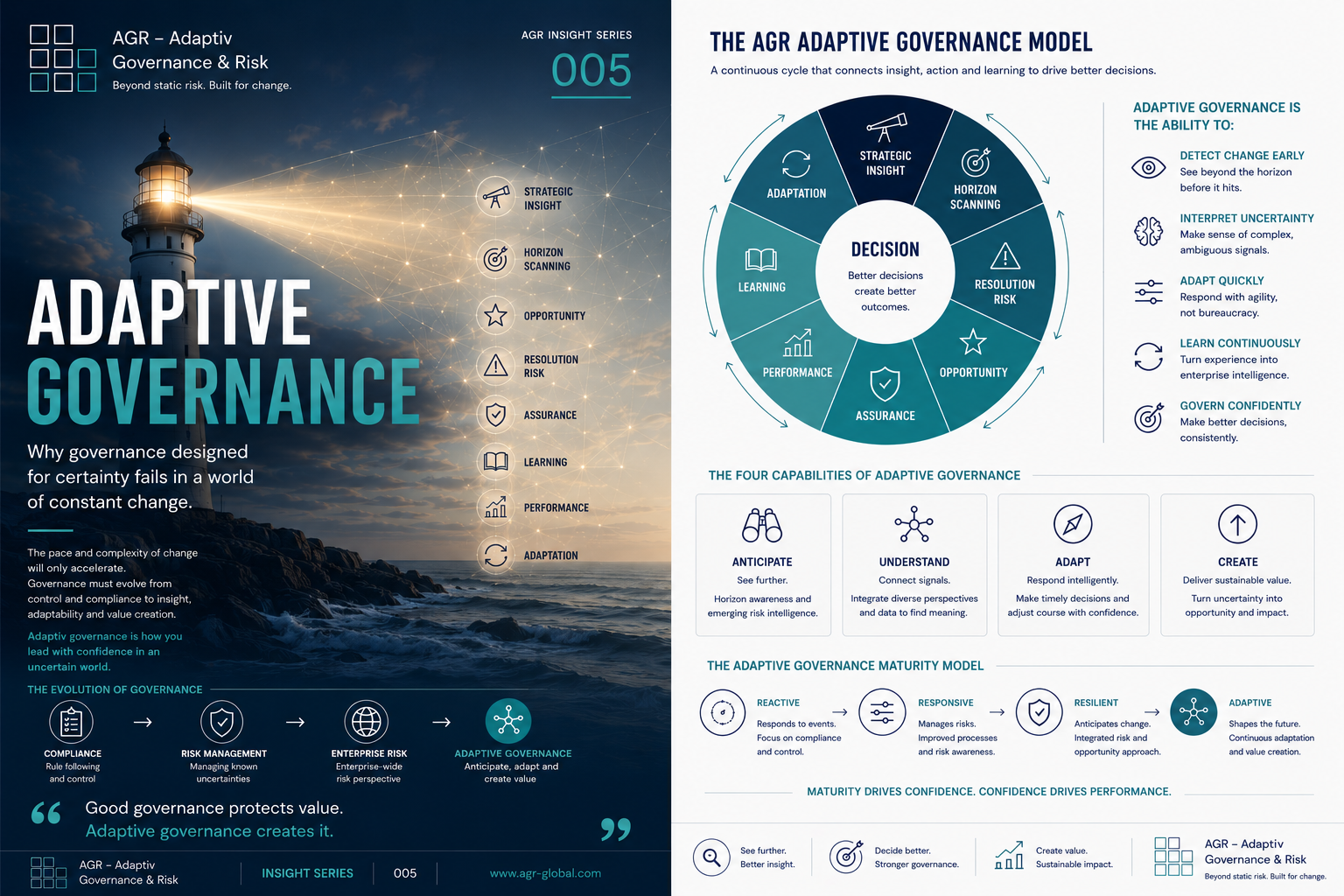
The answer to volatility is not to abandon control. It is to distinguish what must remain fixed, including purpose, accountability, ethics and material boundaries, from what must be able to change, including information flows, decision cadence, authority and assurance.
That distinction turns governance from a static architecture into a living decision system.
Judge governance by the quality of decisions and outcomes it enables, not the volume of process it generates.
Move decisions closer to relevant knowledge while keeping escalation and accountability unmistakable.
Change evidence, cadence and challenge as exposure evolves rather than relying on a fixed annual map.
Use decisions, signals and outcomes to update assumptions before the next disruption forces the issue.
Four connected perspectives move discussion from simplified reporting to clearer judgement and proportionate action.
Notice material changes in context, performance and exposure.
Bring different perspectives together and test assumptions.
Adjust authority, cadence and action to match the conditions.
Use outcomes and new evidence to strengthen the system.
Which governance assumptions no longer reflect reality?
Where is decision speed constrained without improving control?
What must remain fixed, and what should be able to adapt?
The model is valuable when it improves the quality, pace and usefulness of leadership judgement.
Governance should give leaders the confidence to move rather than becoming the reason the organisation cannot.
AGR’s Insight Series is shaped by years of working alongside boards and executive teams in complex, high-consequence environments. Each model is designed to make difficult conversations clearer and practical action more deliberate.
Richard Mackie
Founder and CEO, AGR