
Known problem
State what is not working and why it matters.

Stop managing issues.
Start removing barriers.
The Resolution Risk Model transforms issue management into adaptive governance by making the barriers to resolution visible, actionable and connected to enterprise risk.
Contact AGRThe defining idea
A Resolution Risk combines the operational problem, the barriers preventing resolution and the impact if it remains unresolved. This changes the conversation from describing symptoms to removing constraints.
State what is not working and why it matters.
Define the consequence if the problem remains unresolved.
Identify what is genuinely blocking improvement.
Direct ownership and resources at root causes, then learn.
The Resolution Risk Model
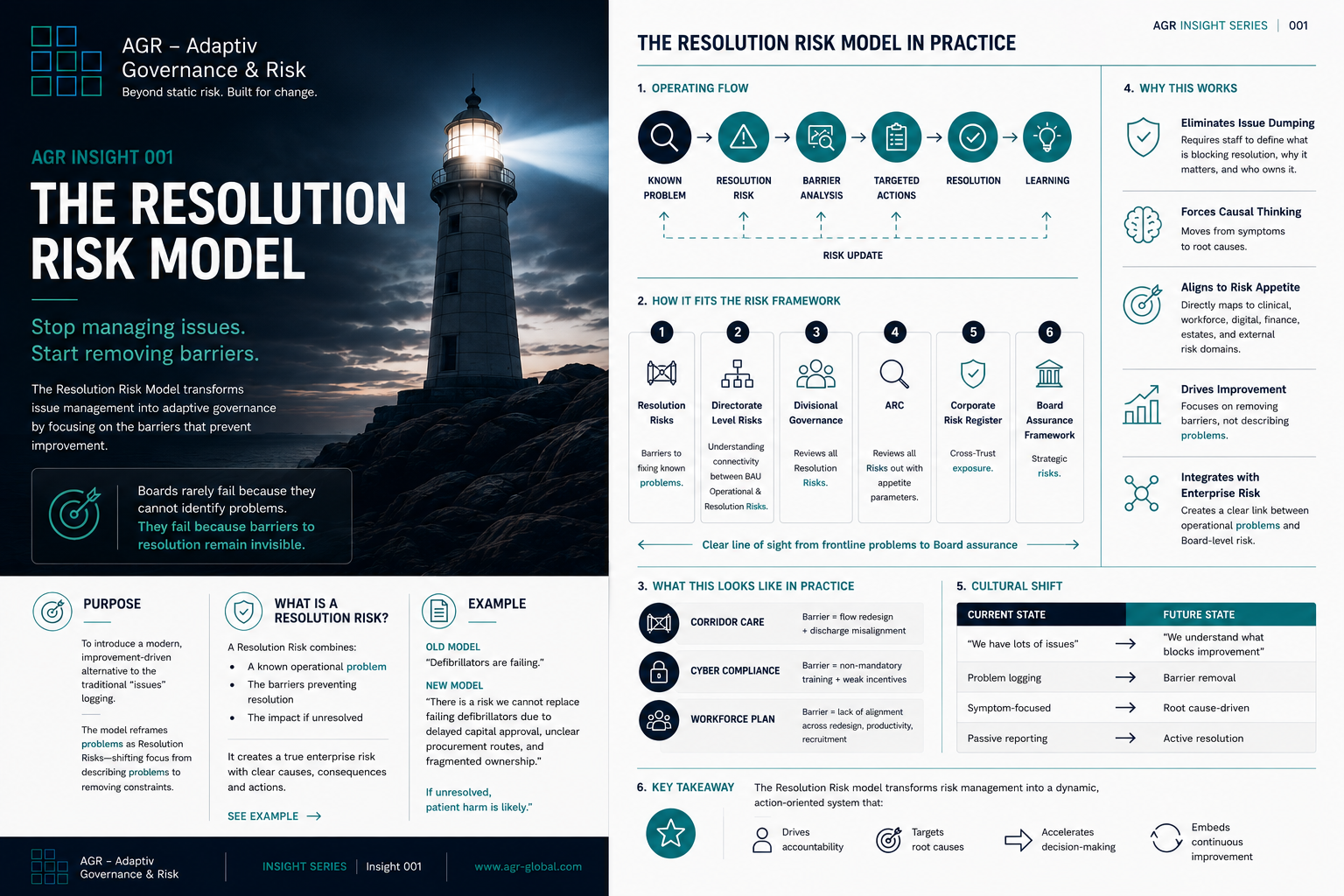
Define the operational issue clearly.
Describe the consequence of continued failure to resolve it.
Expose the root causes and constraints preventing progress.
Assign action directly against the barriers.
Evidence that the underlying problem is genuinely improving.
Feed insight back into the risk view and future decisions.
Enterprise line of sight
Resolution Risks can be reviewed through divisional governance, aligned to directorate risks, tested by the Audit and Risk Committee and connected to the Corporate Risk Register and Board Assurance Framework.
The result is a clear line of sight from barriers affecting day-to-day delivery to the strategic risks and assurances requiring board attention.
What this looks like in practice
Move beyond “defibrillators are failing” to flow redesign, discharge misalignment and fragmented ownership.
Identify non-mandatory training and weak incentives as barriers, rather than repeatedly reporting completion gaps.
Expose misalignment across redesign, productivity and recruitment instead of treating vacancies as the whole problem.
Show whether barriers are being removed, not merely whether the issue remains on a list.

Guidance, not alarm
Bring together the context, causes, dependencies and governance factors shaping the issue.
Make trade-offs visible so leaders can judge what requires attention and why.
Align accountability, resources and decision rights around a credible path forward.
Review progress, learn and adjust rather than treating resolution as a one-off event.
Decision confidence
Focus leadership attention on what genuinely prevents progress.
Clarify ownership, contribution and decision authority.
Move discussion beyond status reporting to choices and consequences.
Build the ability to learn, adjust and sustain progress as conditions change.
The future will bring uncertainty.
Your decisions do not have to.