
Visible ownership and clear accountability.
AGR signature methodology
Governance that enables
confident decisions.
See where governance is creating clarity, where it is creating friction and what must mature next.
10connected capabilities
05maturity levels
03board-ready outputs
A decision capability, not a compliance score
Good governance should make the organisation easier to lead.
Maturity is not measured by the volume of policy, reporting or committee activity. It is measured by the quality of the decisions that governance enables.
AGR combines evidence with executive judgement to establish a credible baseline, expose avoidable friction and focus improvement where it will make the greatest difference.
Sample board output
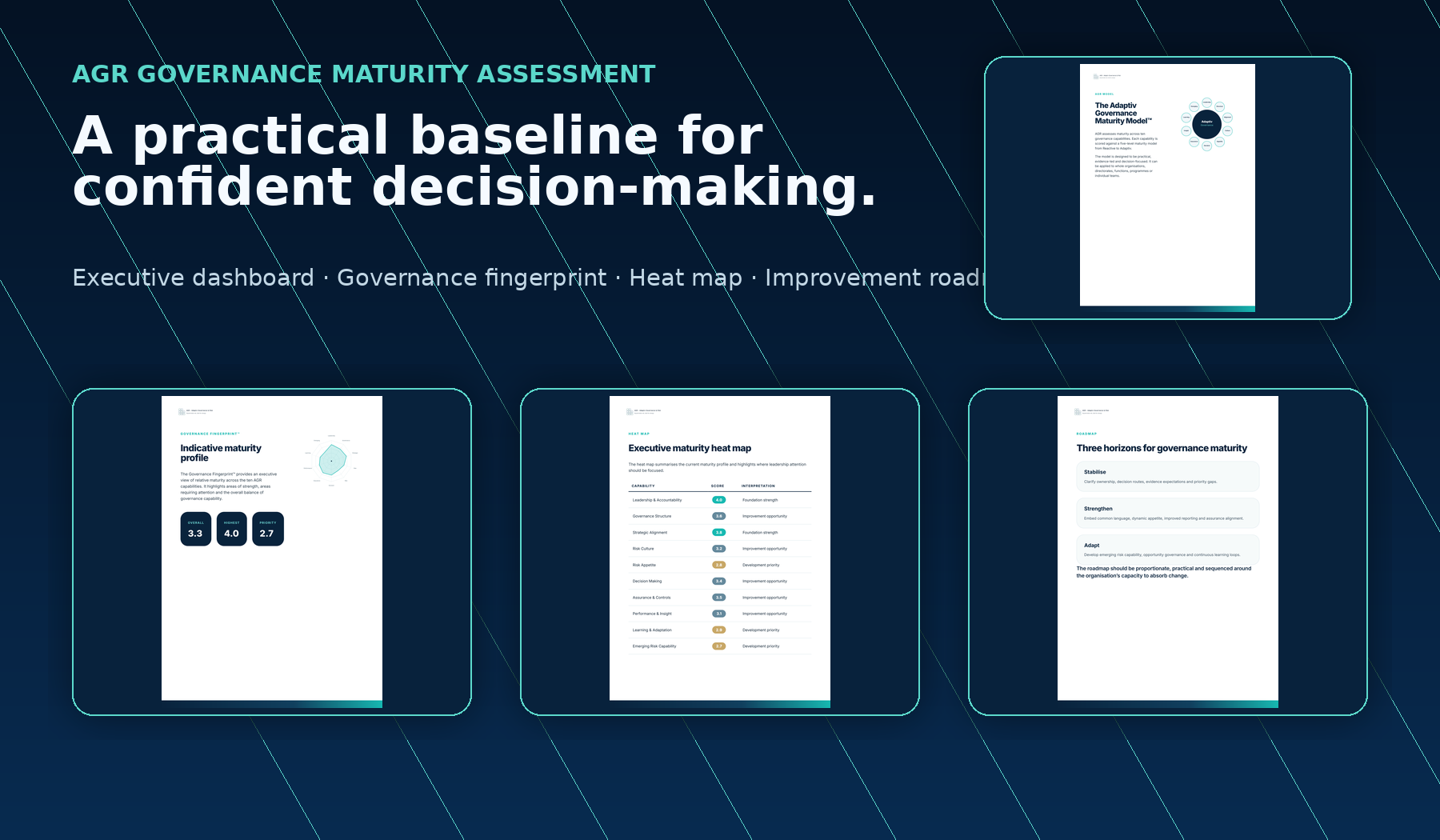
See capability, confidence and priority at a glance.
The Governance Fingerprint™ combines evidence and leadership judgement into a concise view of maturity across ten connected capabilities, supported by an executive heat map and proportionate improvement roadmap.
Maturity means clearer decisions with less friction rather than more committees, policies or reporting.
 Open sample output
Why it matters
Governance can create confidence or create friction.
In a changing environment, organisations need governance that senses change, supports judgement and enables proportionate action.
The assessment helps leaders see where governance is adding value, where it is creating unnecessary burden and where capability must mature to support future performance.
The purpose of governance is not to slow organisations down. It is to give them the confidence to move faster.
The AGR model
The Adaptiv Governance Maturity Model™
AGR assesses maturity across ten connected governance capabilities. Each capability is considered through evidence, judgement and executive insight, creating a practical picture of governance strength and improvement priority.
Forums, routes and delegations that are coherent and understood.
Governance activity connected to strategy and priorities.
Risk and governance understood as part of delivery.
Guidance that helps leaders make proportionate choices.
Governance that creates clarity, pace and confidence.
Controls that are evidenced and proportionate.
Reporting that shows what is changing and where to act.
Governance that improves through experience.
Capability to identify, explore and prepare early.
How AGR assesses
Evidence, judgement and executive insight.
A focused assessment process that combines documentary evidence, leadership engagement, maturity scoring and practical prioritisation.
Review governance documents, reporting, risk information and decision routes.
Interview leaders and facilitate targeted maturity discussions.
Score capability using AGR maturity criteria and evidence framework.
Identify improvement priorities, quick wins and strategic recommendations.
Build a practical roadmap for sustainable governance maturity.
01Governance Fingerprint™
A clear evidence-led picture of maturity across ten connected capabilities.
02Executive heat map
A concise view of strengths, friction and the priorities requiring leadership attention.
03Improvement roadmap
Proportionate actions sequenced around board priorities, capacity and desired outcomes.
AGR perspective
Governance maturity is not about becoming more bureaucratic.
It is about creating an organisation that can make better decisions with greater confidence as circumstances change.